Home > Various > Project procurement: how Caroline Bazin secures supplies at Entrepose Contracting

Project procurement: how Caroline Bazin secures supplies at Entrepose Contracting

22/10/2026

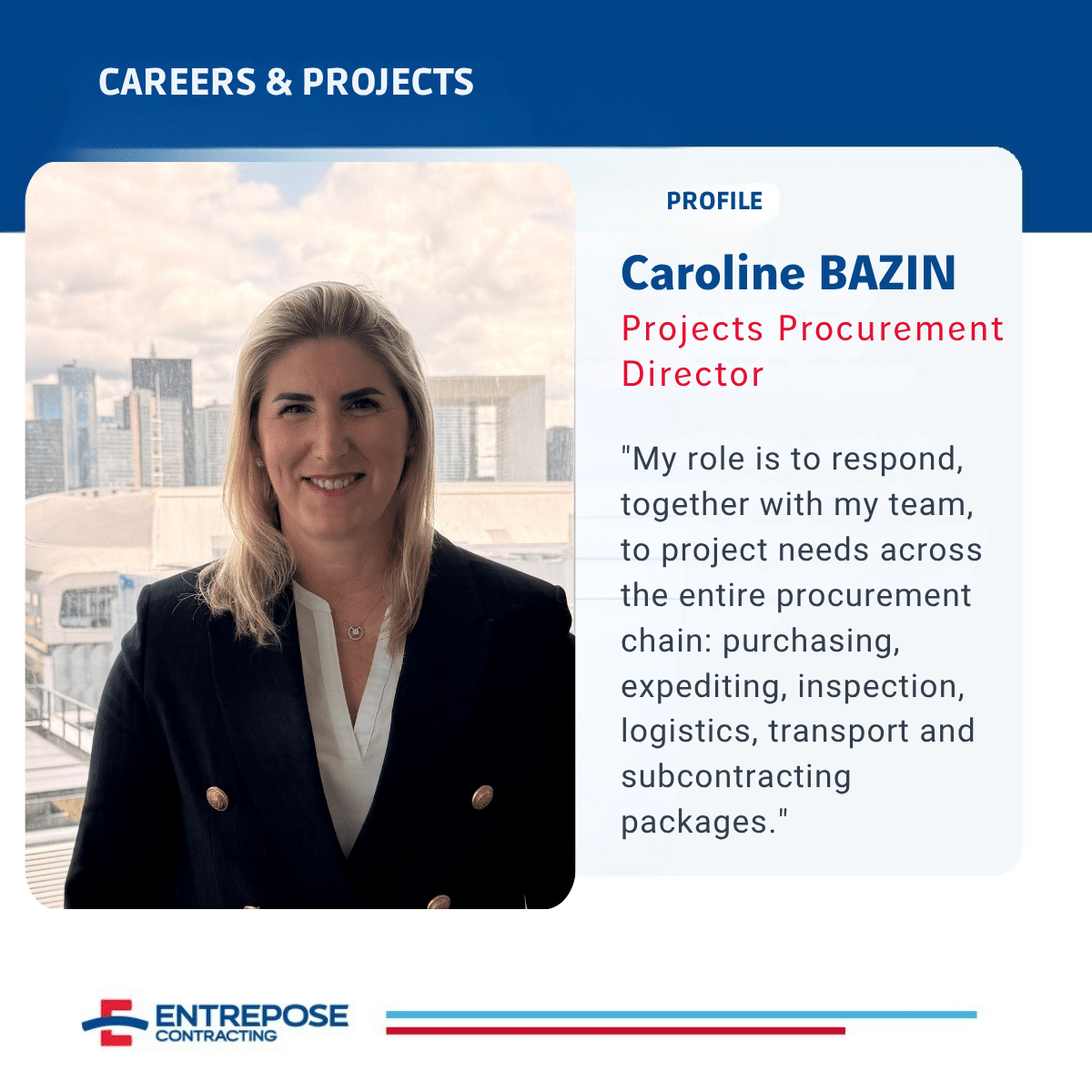
Purchasing equipment, arranging inspections, preparing transport and contracting construction work all form part of the same procurement chain at Entrepose Contracting. Caroline Bazin, Projects Procurement Director, explains how her teams meet project requirements through supplier selection, negotiation and the anticipation of supply risks.

Share:

Developing a procurement strategy for each project

Caroline Bazin’s remit covers purchasing, expediting — monitoring the progress of supplier orders — inspection, logistics, transport and subcontracting packages. This breadth calls for a procurement strategy tailored to each project’s location and requirements, whether these involve equipment, materials, services or construction work.
Supplier sourcing draws on the existing supplier base, market analysis and the assessment of alternative or innovative solutions. Maintaining several qualified partners and monitoring them regularly also helps the teams prepare alternative sources of supply.
Negotiations build on this understanding of requirements and suppliers. When working with strategic partners, the teams analyse previous purchasing volumes and develop a negotiating position that reflects current and future needs. Their objectives cover price, quality, delivery schedules and environmental considerations. Framework agreements are also negotiated to strengthen partnerships.

Bringing expertise together before awarding contracts

For Caroline Bazin, purchasing decisions are part of a collaborative process: “We work in project mode.”
The process begins with a technical package prepared by the engineer, which the buyer or subcontracting engineer then sends to suppliers or subcontractors. Responsibilities are clearly allocated: engineering leads technical clarifications, while the purchasing and subcontracting teams address commercial and contractual matters with support from the legal department.
Before an order is placed, the recommendation is submitted to the relevant departments for validation. Finance approves order and contract values to ensure compliance with the project budget. The quality department is involved from supplier qualification through to execution, covering documentation, factory inspections and the monitoring of subcontracted works on site.
For subcontracting, the Subcontracting Manager leads the process in collaboration with the other departments. Qualification includes financial, quality, health, safety, environmental and ethical criteria. Following the tender process, a recommendation is prepared jointly with the Technical Department and submitted to Project Management for approval. Contract finalisation therefore concludes a process that begins during tendering.

Anticipating supplier risks and preparing alternatives

Financial failure, sharp increases in raw material prices, quality issues and delivery delays are among the supplier risks identified by Caroline Bazin. Legal, regulatory, geopolitical and cybersecurity risks also require attention.
To anticipate these risks, the teams qualify suppliers, assess their performance and put contractual safeguards in place. They also identify alternative suppliers to help address potential supply chain disruptions.
This approach combines contractual understanding with practical procurement experience. With qualifications in business law and international purchasing, Caroline Bazin worked across several sectors before entering the construction industry, developing a broad perspective on procurement.
She now hopes to contribute to the development of procurement and subcontracting within the company while encouraging synergies between Group entities. This ambition follows the same principle that guides her day-to-day role: bringing together the expertise needed to meet project requirements.

Read more news

DAMIEN POUMAER, PROCESS TECHNICIAN

– CONSTRUCTION SITE LOGISTICS: WHEN EVERY PART COUNTS –
On an international industrial construction site, receiving equipment does not necessarily mean it is ready for use. A missing certificate, a non-compliant part, or a customs clearance issue can complicate the progress of the work.

Read more »