Careers that build the world, yet remain little known to young people
The project starts from a clear observation: construction and energy trades are short of talent, and young people know little about them. Young women are even less likely to see themselves in these roles. Schools and companies are sometimes disconnected, and awareness initiatives, often theoretical, leave little room for first-hand experience of a construction site.
In these conditions, it is hard for anyone to picture themselves in a job they have never seen up close. Hence the question at the heart of the project: how can technical vocations be revealed in young people, girls and boys alike, by reducing stereotypes and making construction and energy tangible and attractive?
A hands-on mini construction site that goes out to meet young people
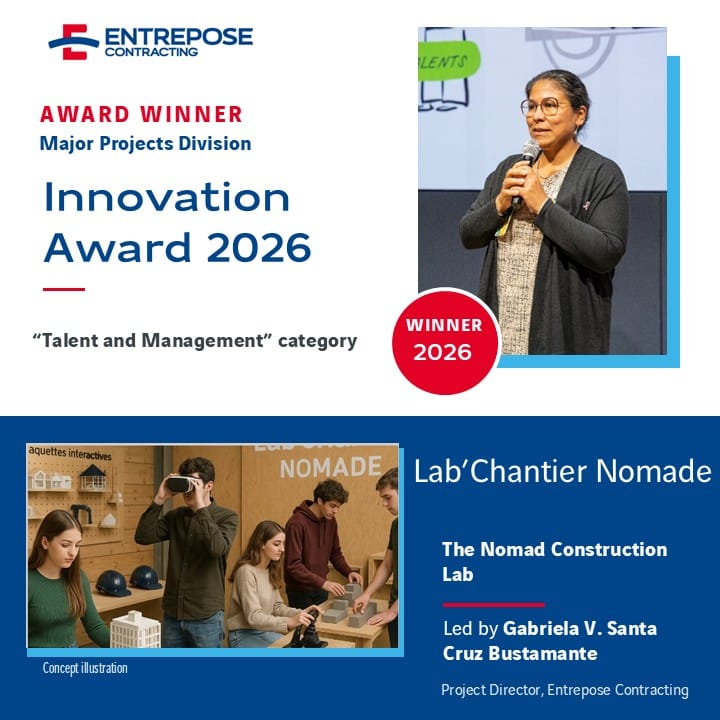
The Lab’Chantier Nomade (Nomad Construction Lab) is a concept for a mobile, hands-on mini construction site housed in a container, devised within Entrepose Contracting, a subsidiary of VINCI Construction Grands Projets, by Gabriela V. Santa Cruz Bustamante. Designed for secondary school students and apprentices in vocational training centres, it aims to introduce them to technical careers in construction and energy through practice, in order to reduce stereotypes and inspire vocations. On 13 October 2026, it received the Major Projects Division Innovation Award in the “Talent and Management” category.
The container would be fitted with interactive scale models (underground networks, tanks, structures), safe tools suited to first-time users, simple simulators (light virtual reality, technical gestures) and sustainability modules covering recycled materials, green energy and safety.
The experience would take the form of a 60- to 90-minute practical session. The construction site would thus come to young people, who could discover, experiment and picture their future within their own school.
The Nomad Construction Lab at a glance
▪ What: a container converted into a mobile, hands-on mini construction site.
▪ Who for: secondary school students and apprentices, girls and boys alike.
▪ How: a 60- to 90-minute practical session held on school premises.
▪ Why: to discover technical careers, reduce stereotypes and inspire vocations.
Status: concept awarded the 2026 Major Projects Division Innovation Award, “Talent and Management” category.
An innovation in use rather than in technology
The project combines four dimensions: mobility, immersion, experimentation and proximity. According to the analysis set out in the project submission, existing formats cover only some of them: a careers fair takes place at school without immersion, while a construction site experience immerses young people but requires them to travel to the site.
The concept requires no technological breakthrough. Its implementation would involve an HR/CSR project manager, career ambassadors, a safety officer and a standard converted container. The planned phases include two months of design and one to two months of fit-out, followed by a six-month pilot.
What the project aims to achieve
The project submission identifies expected benefits for three audiences.
▪ For young people: hands-on discovery of the trades, an immersive experience rather than a theoretical presentation, and a better understanding of study paths and work-study programmes.
▪ For employees: a role as career ambassadors, the development of communication and teaching skills, and pride in contributing to the future of the profession.
▪ For the company and society: a pool of future interns and work-study students, stronger links between schools and companies, and a contribution to gender diversity and equal opportunities.
This last objective is in line with our commitment to diversity, equality and inclusion. These effects have yet to be measured: they are the outcomes that the planned pilot would make it possible to assess.
An initiative driven from within
Holding a PhD in Chemistry, Gabriela V. Santa Cruz Bustamante began her career as a process engineer in a design office before joining Entrepose Contracting, where she moved into engineering management and then project management. The first woman to hold a Project Manager position within VINCI Construction Grands Projets, she is now Project Director for the Cartagena LPG project. Her career path sheds light on the purpose of her proposal: making technical careers visible from school onwards, careers that many young people, and young women in particular, do not yet consider.
“Young people do not choose careers they know nothing about. With the Nomad Construction Lab, we want to close the gap between them and our professions, and bring schools closer to construction sites.”
Gabriela V. Santa Cruz Bustamante, Project Director, Cartagena LPG project, Entrepose Contracting
Designed for one entity, conceived for the Group
Simple, mobile and modular, the concept has been designed to be transferable. The project submission envisages deployment across VINCI entities facing recruitment pressures, with teaching modules adapted to each business, followed by gradual extension at regional, national and international level.
As the project submission puts it, the real innovation is not the container: it lies in taking the construction site to where vocations are born. This conviction reflects our values and commitments.
Interested in careers in energy and construction? Explore our careers and the paths of the people who pursue them.