
The arrival of the first LNG carrier marked a historic moment for the LNG Canada project. This inaugural cargo initiated...
Building a liquefied natural gas terminal, an energy infrastructure or a complex industrial facility requires technical expertise, skilled teams and substantial investment. Yet, even before the first operations begin on site, another equation must be resolved: how can the financial conditions required to deliver the project be secured while keeping the associated risks under control?
For international projects, this question can prove decisive. The scale of the investment, the number of partners involved, regulatory constraints and the specific economic environment of each country all call for tailored solutions.
This is where the International Financing Department at VINCI Construction Grands Projets comes in.
“We support operational divisions in arranging financing, issuing guarantees and covering the risks of contract interruption,” explains Cyril Guignard.
His remit extends across the entire Major Projects division, including Entrepose Contracting. He is involved both during the tendering phase and throughout contract execution.
The challenge therefore goes beyond securing financing alone. It also involves developing a competitive proposal for the client, safeguarding contractual commitments and anticipating events that could disrupt the project.
Cyril Guignard’s day-to-day work spans three distinct areas: operational teams, financial partners and external stakeholders.
On the one hand, he works with bid managers and project teams to understand their requirements and contractual constraints. On the other, he coordinates discussions with banks, financial institutions, insurers and brokers. He also liaises with clients, lenders and, in some cases, public authorities.
This cross-functional position requires both strong financial expertise and a clear understanding of operational challenges.
An appropriate financing solution must reflect the specific characteristics of the project: its contractual environment, schedule, organisation and the client’s expectations. To identify the best option, the teams seek several proposals and compare them against two essential criteria: competitiveness and suitability for the project’s needs.
Securing favourable terms, however, is not enough. The various stakeholders must also be coordinated to ensure that every stage progresses according to schedule. The client, Ministry of Finance, banks and consultants all have distinct responsibilities. The International Financing Department must act as a driving force throughout the process by anticipating the necessary steps, monitoring deadlines and facilitating discussions.
This approach is based on a simple principle: break the process down into clear stages, define responsibilities and move forward with discipline.
Au printemps 2025, les équipes de financement de VINCI Construction Grands Projets ont franchi une étape majeure avec la clôture du financement du projet RIO COBRE, en Jamaïque. Ce projet, présenté comme le premier partenariat public-privé de ce type dans les Caraïbes, représente un investissement global de 90 millions de dollars. Il repose sur une société de projet dans laquelle VINCI participe à hauteur de 30 %, et sur l’engagement de plusieurs partenaires financiers jamaïcains et internationaux, parmi lesquels Proparco et la Banque interaméricaine de développement.
La particularité de ce montage tient notamment à son horizon de réalisation : deux années de travaux, suivies de 23 années d’exploitation par les équipes locales, au service de la National Water Commission, client historique de VINCI en Jamaïque. Un partenariat public-privé (PPP) associe des acteurs publics et privés autour de la réalisation et, selon les contrats, de l’exploitation d’une infrastructure. Sa réussite suppose de définir les engagements de chaque partie et de réunir des partenaires financiers capables d’accompagner le projet.
Pour Cyril Guignard, l’enjeu de ce type d’opération est autant financier qu’organisationnel. La clôture du financement constitue l’aboutissement d’un travail collectif : faire converger les exigences des prêteurs, les engagements des partenaires et le calendrier du projet.
RIO COBRE illustre ainsi une dimension essentielle des financements internationaux : accompagner non seulement la construction d’une infrastructure, mais aussi les engagements pris sur plusieurs décennies.
This expertise also applies to Entrepose Contracting’s industrial and energy projects.
In 2022, the teams reached financial close on a GBP 130 million financing package for National Grid, the client for the Grain LNG project in the United Kingdom. This transaction illustrates the role financial support can play in the relationship with an industrial client.
During a tender process, when a client is also seeking a financing solution, the cost of that financing becomes an important component of the commercial proposal.
Competitiveness can no longer be assessed solely on the basis of the cost of engineering, equipment or construction work. It must be considered across the entire proposal, combining the project’s technical characteristics with its financing arrangements.
For Cyril Guignard, this does not necessarily mean choosing between the price of the bid and the cost of financing: both dimensions must be optimised together. This approach gives finance a direct role in developing the proposal and supporting the client.
Financing is only one of the department’s three core responsibilities. The other two relate to guarantees and coverage against the risks of contract interruption.
On international projects, several types of events may compromise contract performance, including political crises, administrative decisions, serious commercial difficulties and payment defaults.
To protect the company against some of these situations, the teams arrange appropriate insurance policies and monitor them throughout the project lifecycle.
These policies can protect the company against major and prolonged disruption to contract execution, certain unpaid amounts and wrongful calls on guarantees. They do not eliminate risk, but they can mitigate some of its financial consequences under the circumstances defined in the insurance contract.
This responsibility is particularly important in countries exposed to political or economic instability. It is not merely a matter of theoretical prevention. In recent years, the teams have had to activate these insurance policies on several projects, notably in Egypt, Vietnam and Senegal.
Risk management also depends on appropriate contractual provisions. In an inflationary environment, for example, including price adjustment formulas makes it possible to better reflect changes in the cost of materials and services. These mechanisms are based on indices that accurately represent the project’s cost structure, such as those relating to concrete, steel or consumer prices.
Foreign exchange risks and cash flow requirements are handled by the division’s Treasury Department, as part of a complementary allocation of financial responsibilities.
The shared objective is to preserve, as far as possible, the economic and contractual conditions required for the successful delivery of the projects.
Cyril Guignard’s career path explains his strong understanding of the challenges faced by operational teams.
He joined VINCI in 2005 and initially worked on water infrastructure projects in Central Asia. After returning to head office, he spent several years contributing to the preparation of tenders for international projects, including projects relating to Chernobyl and the Cairo Metro.
He then served for four years as Finance and Administration Director of an operational division. In 2016, he joined the International Financing Department, where he has held his current position ever since.
This combination of experience in project delivery, tender preparation and financial management has given him a comprehensive understanding of the constraints faced by project teams.
It also highlights one of the defining features of the role: the ability to address very different challenges depending on the country, the client and the contractual structure.
“Every one of our projects is bespoke. The same applies to our work: our assignments are constantly evolving, leaving no room for routine.”
On major international projects, engineering and construction roles are often the most visible. Yet successful delivery also relies on complementary areas of expertise, mobilised well before work begins on site and remaining involved throughout contract execution. International financing is one of them.
By combining project knowledge, coordination with financial partners and risk management, this function helps transform an industrial proposal into a viable project while safeguarding the commitments made.
For Entrepose Contracting, having access to this expertise within VINCI Construction Grands Projets provides an additional lever through which to support its clients.
Cyril Guignard’s career is a reminder that major industrial projects are not built on technical expertise alone. They also require the right financial, contractual and human conditions to bring them successfully to completion.
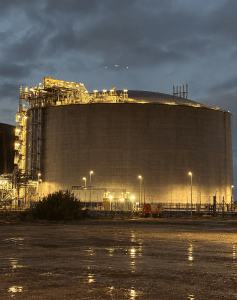
Grain LNG is Europe’s largest LNG import and regasification terminal. With 1.2 million m³ of LNG storage capacity, it can meet nearly one third of the United Kingdom’s gas demand. The terminal serves several major international energy companies and plays an essential role in the
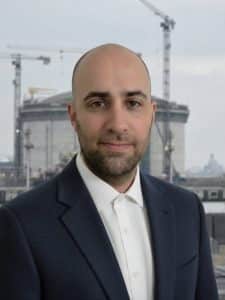
At Entrepose Contracting, Sébastien Vicens heads the Materials, Welding and Quality Control Department. From tendering through to execution, he supports project teams in their technical choices to ensure the compliance and reliability of installations. His role combines materials expertise, construction preparation and collaboration across disciplines.