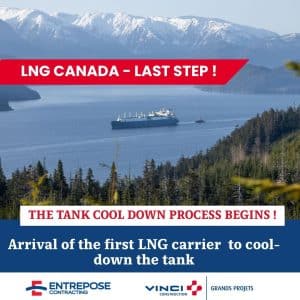
The arrival of the first LNG carrier marked a historic moment for the LNG Canada project. This inaugural cargo initiated...
At a glance
EPC, consortium Entrepose Contracting / VINCI Construction Grands Projets / ORASCOM (Entrepose lead partner, ≈ 60%)
Skikda is a major Sonatrach liquefaction complex, supplied with gas from the Hassi R’mel field. The extension project increased LNG and LPG storage and export capacity, strengthening Algeria’s position as a key Mediterranean and European gas supplier.
What was your role on the Skikda project?
I joined the project as Project Director while construction was already under way, with the foundations and concrete walls in progress. The project organisation was already established, but a significant amount of work still had to be completed.
Our scope included building several structures simultaneously: one LNG tank, two LPG tanks, and one sphere.
What was the main particularity of the project?
We were working as part of the reconstruction of a gas complex that remained partially operational throughout the works. Gas was still continuously entering the facility.
Near our construction area, a flare about thirty metres high could activate without warning to relieve excess gas. The flame was impressive, but the heat it generated was the main constraint. It was simply another operating condition we had to integrate into our construction planning and day-to-day site activities. The project also relied heavily on local skills.
How was this organised?
We relied extensively on Entrepose Algeria, both to recruit local teams and to bring in experienced personnel from other projects across the country.
However, a significant proportion of the workforce also needed training. We therefore set up a welding school. Building a team of around one hundred welders capable of meeting the project requirements meant training many more candidates and selecting those who could perform the most critical welds.
Beyond the project’s immediate needs, this was also about transferring skills that could be used on other industrial projects.
Was there one operation that particularly illustrates the importance of practical site expertise?
The sphere erection is a good example. On paper, the erection and welding sequences are defined very precisely. But in practice, welding, heat, and even sun exposure can distort the steel plates.
This is where the experience of construction supervisors and site teams becomes critical. Some situations cannot be fully described in a procedure. You need people who have faced these issues and know how to adjust the assembly while maintaining the required quality and structural integrity.
What did Skikda teach you beyond the technical aspects of the project?
The importance of knowledge transfer. We had supervisors and foremen who had spent their entire careers building tanks. Their expertise came as much from years of hands-on experience as from procedures and technical documentation.
Documented lessons learned are essential, but they can never capture everything that happens on a construction site. A company also retains its know-how by ensuring that experienced people can pass their knowledge from one project to the next.
Skikda also reminded me how important the human dimension is when teams live and work together over a long period. In a constrained environment, maintaining team cohesion, communication and a strong collective spirit is also part of successful project management.