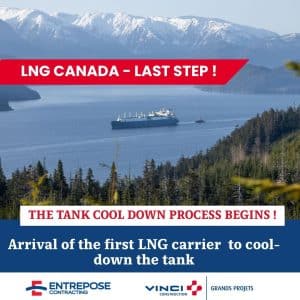
The arrival of the first LNG carrier marked a historic moment for the LNG Canada project. This inaugural cargo initiated...
At a glance
turnkey EPC contract, delivered by a VINCI consortium (Entrepose Contracting / VINCI Construction Grands Projets / Taylor Woodrow)
Grain LNG is Europe’s largest LNG import terminal, with 8 tanks in operation and an annual regasification capacity of around 20 billion m³ (bcm). In 2020, National Grid signed a 25-year capacity agreement with Qatar Petroleum, launching the Capacity 25 expansion programme, which included the addition of one tank and associated equipment.
Objective: increase capacity by 25%, from 20 to 25 bcm per year—nearly one third of the UK’s gas demand—and strengthen security of supply.
Operations & environment: works within an operating terminal, in a sensitive ecological area. Enhanced industrial safety and environmental protection measures (wetlands, protected fauna/flora).
Technical complexity: integration of the tank into existing networks with no shutdown. The 190,000 m³ tank includes slipformed concrete outer containment and a pneumatically lifted steel dome.
Integrated EPC: the VINCI JV delivers the complete Engineering–Procurement–Construction (EPC) scope to secure quality, safety, and contractual performance.
What was your role on the Grain LNG project?
I was the Project Director. I started working on Grain as soon as the contract was signed in January 2021, initially from head office to launch engineering and procurement. I then moved to site in October that year to be present during the geotechnical investigation campaign and work alongside the teams and the client.
On a project like Grain, the centre of gravity quickly shifts to the construction site: you need to make timely decisions, oversee execution first-hand and maintain a very close relationship with the client.
What made Grain different from the other LNG projects you had worked on?
The post-COVID context was one factor, combined with working in the UK, where the local working culture brings its own particularities.
Most of the site teams were British, particularly those involved in civil works and subcontractor management. You need to understand local practices, processes and ways of working. That requires a great deal of listening, trust and adaptability.
We also had to navigate the consequences of the conflict in Ukraine, including significant pressure on the availability and pricing of certain supplies.
Did the project also provide an opportunity to develop new construction methods?
Yes. In particular, we implemented a new approach to roof design and assembly.
On this type of project, there can be a temptation to repeat what has worked before. But sometimes you need to question established practices and find a solution better suited to the project’s specific constraints.
That also means bringing people on board. You cannot decide on a new method alone: you need to challenge the teams, demonstrate why the solution is appropriate and secure the client’s support.
Y a-t-il une phase du chantier qui résume particulièrement bien la pression d’un projet comme Grain ?
Constructing the wall using slipforming, followed by air-raising the steel dome, may seem an unconventional choice to those familiar with LNG tank construction. Yet it resulted from a carefully considered approach.
Slipforming runs around the clock for approximately three weeks. If the operation goes wrong, the consequences for the programme and costs can be considerable.
The dome air raising is different, but just as intense: you spend nearly three months preparing the operation, and within a few hours, all that work is put to the test. The lift at Grain went very smoothly, but the pressure remains high until the very end.
What further lessons did Grain teach you about managing a major project?
It reinforced how important it is to have a robust management system that aligns all partners around a common objective. That foundation helps you keep shifting between different levels of perspective.
A Project Director sits at the intersection of a continuous flow of information and decisions, some of which are irreversible. You need to make those decisions day to day while assessing their consequences six months, a year or two years ahead.
Above all, you need to rely on your team. For me, trust, transparency and the quality of working relationships are essential. Everyone must feel able to speak openly, flag a problem or acknowledge a mistake. That is how you make the right decisions at the right time.