MUCH MORE THAN JUST RECEIVING EQUIPMENT
At a construction site for liquefied natural gas (LNG) storage tanks, thousands of pieces of equipment, components, and materials must be received, inspected, and made available to the crews.
Behind this organizational effort lies a key challenge: ensuring that every item meets the project’s requirements and can be used under the right conditions.
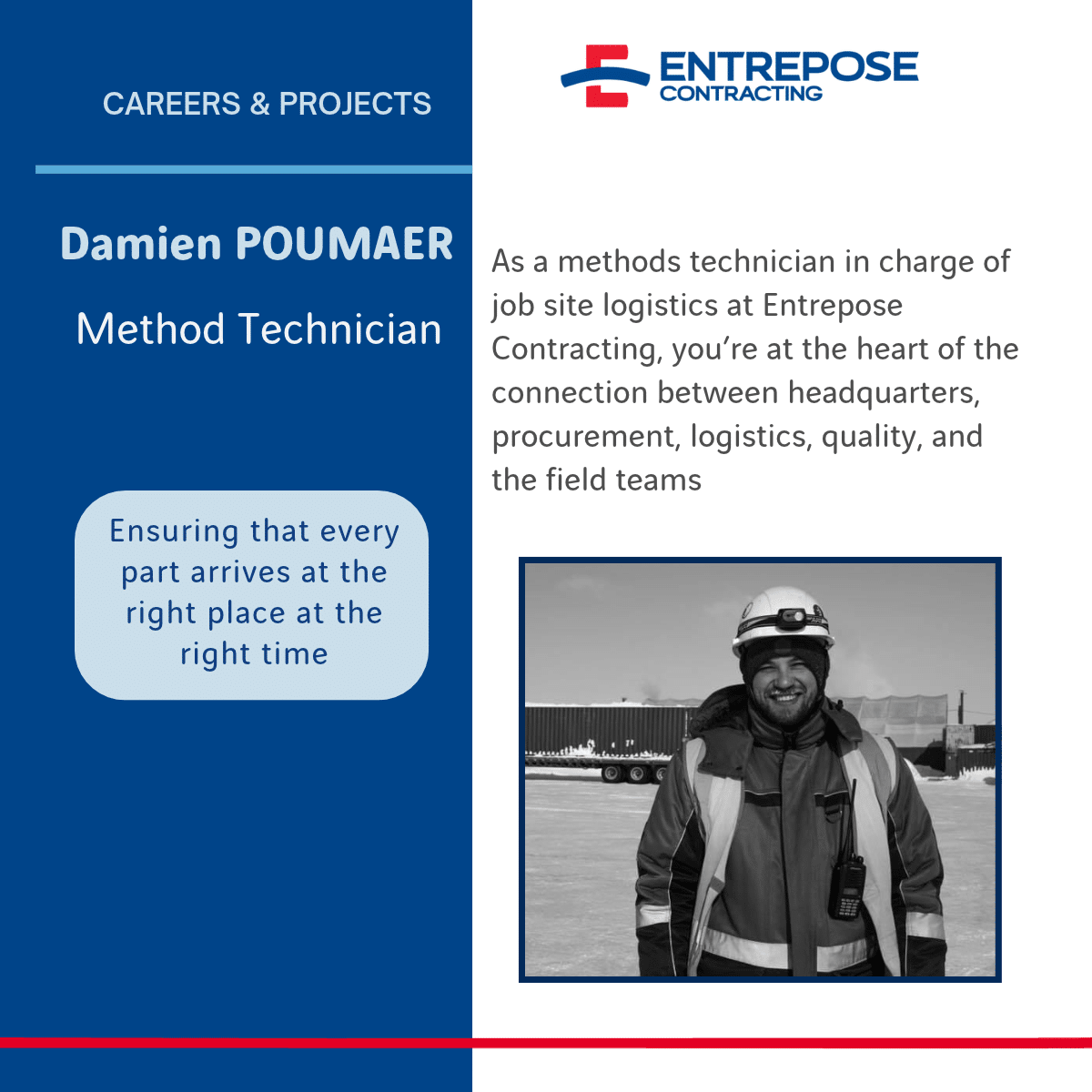
This is precisely the role that Damien Poumaer fulfilled at Entrepose Contracting, a subsidiary of VINCI Construction Grands Projets.
“ My role is to ensure that the equipment arrives on site in good condition, that it is compliant, properly documented, and available when the teams need it,” explains Damien Poumaer.
Working at the intersection of procurement, logistics, quality, and operations, Damien serves as the link between headquarters-managed procurement and the actual needs of the construction site.
His role begins at the time of receipt: inspecting the condition of the equipment, identifying any damage or missing parts, verifying material certificates, and ensuring they match the technical documentation.
If any discrepancies are found, they must be reported, documented, and resolved in coordination with the relevant parties. Non-compliant equipment must be identified and isolated to prevent any inappropriate use.
This methodical work is essential to maintaining operational continuity.
TRACEABILITY: KNOWING WHERE EACH PART COMES FROM AND WHERE IT’S GOING
In energy infrastructure construction, equipment tracking goes beyond a simple inventory.
Each component must be identifiable, linked to its technical documentation, and tracked until it is used.
This traceability directly contributes to ensuring the quality of the structures.
For LNG storage tank projects, documentation requirements are particularly important: material certificates, compliance checks, and inspection reports are all included in the facility’s final quality file.
Equipment whose origin or compliance cannot be verified may become a problem as the work progresses.
“Without traceability, we don’t know exactly where a part comes from, what it’s intended for, or under what conditions it was used.”
This vigilance also ensures that teams have the necessary information during inspections, verifications, and the preparation of the final project documentation.
This is where meticulous documentation comes into its own: it links the day-to-day operations on the construction site to the quality requirements for the completed project.
IN THE INTERNATIONAL BUSINESS WORLD, ANTICIPATING THE UNEXPECTED IS PART OF THE JOB
Dunkirk, Yamal in Russia, LNG Canada… Damien’s career has taken him to projects with very different environments and organizational structures.
Every construction site has its own logistical, regulatory, and operational challenges. Distances, customs procedures, weather conditions, and the organization of subcontractors all require a constant ability to adapt.
Damien particularly recalls a challenge he faced on a construction site in Russia.
A heavy-lift crane, needed for lifting operations, was to be shipped to the site by boat. But upon its arrival at the port, customs clearance procedures had not been completed.
It was impossible to transfer all the equipment directly to its destination area.
To avoid further delaying the ship, the teams had to organize the unloading and temporary storage of the equipment on the dock before they could continue transporting it.
This situation illustrates a reality of international industrial shipyards: a documentation issue can quickly become an operational constraint.
It also highlights a safety concern. Each additional handling of bulky equipment requires new lifting, moving, and coordination operations.
By planning ahead for the necessary procedures, verifying documents, and coordinating with all parties involved, we can minimize disruptions and unnecessary steps.
THE HUMAN FACTOR: ESSENTIAL TO THE SUCCESS OF OPERATIONS
Through his experiences, Damien has come to believe that technical expertise alone is not enough to move a construction project forward.
In Russia as well as in Canada, he had to learn to work with local teams, understand their professional practices, and adapt to different organizational structures.
Construction site constraints, work habits, and relationships among stakeholders vary from one country to another. Effective communication therefore becomes essential for resolving challenges.
Listening, explaining, building trust, and respecting everyone’s role: these are all skills that facilitate day-to-day coordination.
For Damien, this collaborative aspect is not secondary. It lies at the heart of his professional approach.
Site logistics is therefore also a profession centered on human relations. One must know how to communicate with procurement, suppliers, quality managers, and construction teams—sometimes under time pressure—while maintaining a shared goal.
FROM MATERIAL CONTROL TO PROJECT CONTROL: GROWING THROUGH FIELD EXPERIENCE
At the time of his interview, after nearly thirteen years at Entrepose Contracting, Damien was continuing his professional development.
His experience in equipment control has given him a very practical understanding of the interactions between procurement and project execution.
When equipment is missing or a delivery is delayed, the consequences can extend beyond equipment management: it is sometimes necessary to reassess priorities, reorganize work activities, or adjust the sequence of operations.
This cross-functional perspective gradually led him to take an interest in scheduling and project control, areas in which he is now developing his skills.
This career progression is driven by his curiosity and his desire to better understand the various dimensions of a project.
For him, learning about other disciplines is essential. Engineering, procurement, construction, and planning: each discipline provides part of the solution to the challenges encountered on-site.
This open-minded approach allows him to go beyond the boundaries of a single specialty to better understand the overall functioning of an EPC project.
ADVICE FOR YOUNG PROFESSIONALS: LEARN ON THE JOB