
The arrival of the first LNG carrier marked a historic moment for the LNG Canada project. This inaugural cargo initiated...

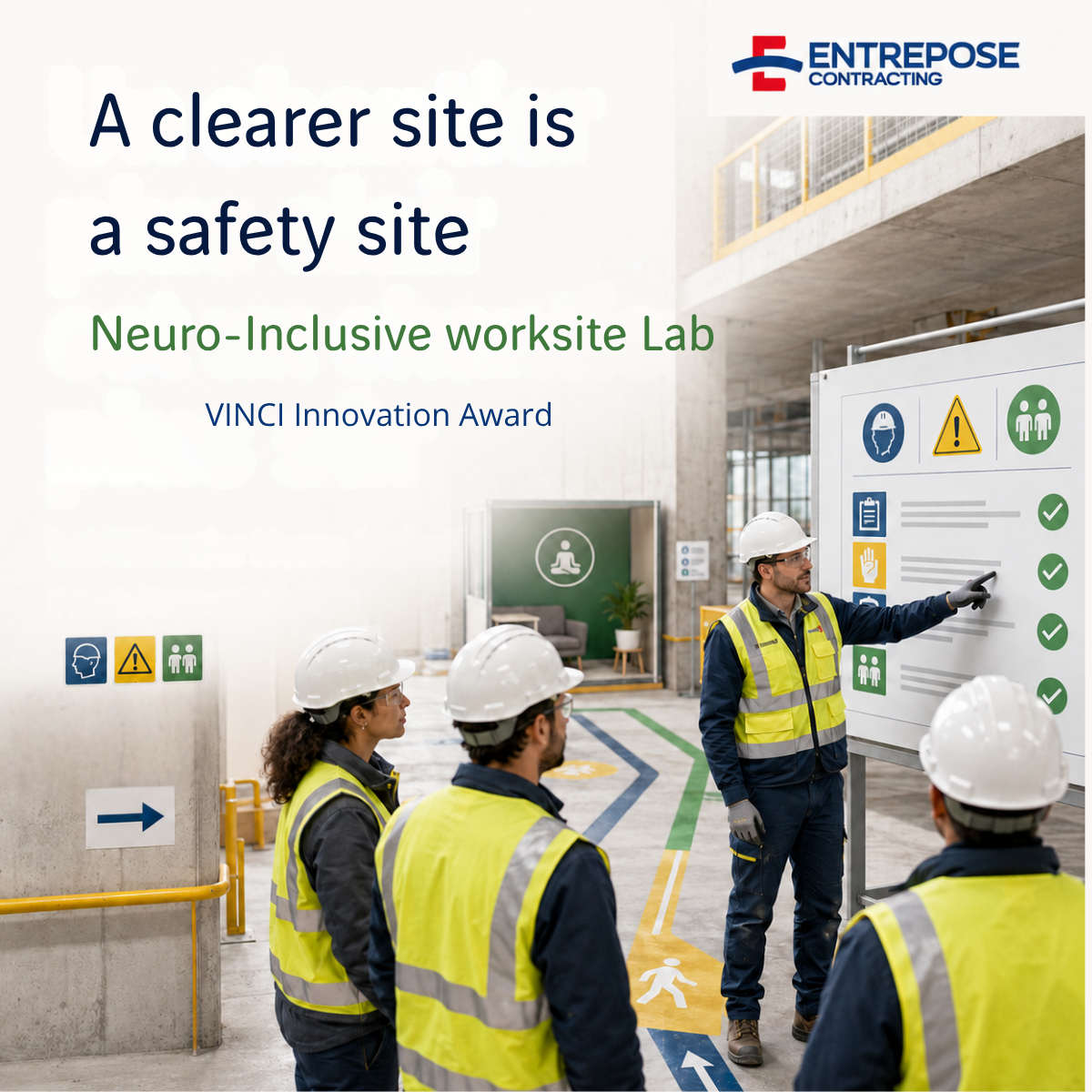
This observation led to the creation of the Neuro-Inclusive Construction Site Lab, an initiative led by Entrepose – DECN. Its ambition: to test simple, concrete and low-tech adaptations in the field to make construction sites more accessible to neurodivergent profiles, particularly people with autism spectrum disorder, DYS disorders or ADHD.
The challenge goes beyond inclusion alone. By improving the readability of instructions, the clarity of visual cues and the quality of briefings, the project also aims to strengthen safety, reduce execution errors, facilitate team integration and improve collective performance.
A construction site is a demanding environment. Information circulates quickly, instructions are often given verbally, priorities evolve throughout the day, and teams must deal with noise, co-activity, safety constraints and schedule pressure. In this context, clear guidance and effective communication are not secondary issues: they directly influence safety, execution quality and collective performance.
However, not all employees process information in the same way. Some neurodivergent profiles may experience greater difficulty in environments that are very noisy, constantly changing or heavily dependent on rapid verbal instructions. This does not call their skills into question. Rather, it shows that the way work is organised can sometimes create unnecessary barriers.
Talking about neuro-inclusion on construction sites, therefore, means asking a very operational question: how can the working environment be made clearer, more structured and more accessible, without slowing down activity or making methods more complex?
On construction sites, the transmission of instructions still relies heavily on verbal communication. A briefing, a quickly delivered instruction, an additional clarification between two operations, a change in priority communicated urgently: these practices are part of everyday site life. They are often effective for experienced teams that work well together, but they can also create uncertainty.
The issue does not come only from the instruction itself. It comes from its context: ambient noise, schedule pressure, co-activity, multiple stakeholders, frequent changes, technical vocabulary and sequences of tasks to be carried out quickly. In these conditions, information may be heard without being fully understood, understood differently by different people, or forgotten at the moment of action.
These situations particularly affect neurodivergent profiles, but not exclusively. A new starter, a non-French-speaking employee, a temporary worker, a subcontractor or a site worker assigned to a new task may encounter the same difficulties. An overly implicit instruction can then become a source of stress, repeated explanations, lost time or execution errors.
The Neuro-Inclusive Construction Site Lab is based on a simple conviction: making a construction site more inclusive does not always require adding complexity. Certain concrete, visual, and low-cost adaptations can transform how instructions are understood, how teams navigate their environment, and how each person finds their place within the organisation of work.
The objective of the Lab is to test, on a pilot construction site, a set of solutions that can be directly applied in the field:
• enhanced cognitive signage using pictograms, colour coding and visual markers;
• more structured instructions through checklists, laminated materials and illustrated step-by-step guides;
• standardised visual briefings to make messages shorter, clearer and more actionable;
• sensory refuge areas to temporarily reduce overload linked to noise or pressure;
• neuro-inclusive mentoring to support teams through clearer communication;
• manager micro-training to give supervisors simple, practical reflexes.
The strength of the project lies in its pragmatism. It is not a theoretical concept, but a testable, measurable and replicable system..
The Neuro-Inclusive Construction Site Lab is part of a highly concrete approach to innovation. It does not aim to create an announcement effect or add a system disconnected from operational realities. Its ambition is more direct: to transform the conditions in which teams work, understand instructions, find their bearings and cooperate on a daily basis.
On a construction site, innovation only has value if it withstands real-life use: noise, time constraints, organisational changes, co-activity, safety requirements, language differences and varying levels of experience. A relevant solution must therefore be easy to understand, quick to deploy and compatible with existing methods.
This is precisely the strength of the Lab. It is based on low-tech adaptations that can be tested immediately. These tools do not change the purpose of the construction site. They improve the way information circulates, the way actions are understood and the way each person can contribute with greater clarity and safety.
Innovation also lies in a shift in perspective. Rather than treating inclusion as a process separate from performance, the project demonstrates that it can serve as an operational lever. Better structuring instructions, reducing implicit information and making visual cues more visible: these actions benefit neurodivergent people, while also strengthening collective efficiency.
The Neuro-Inclusive Construction Site Lab is fully aligned with the commitments upheld by Entrepose and the VINCI Group: delivering demanding projects while placing safety, human responsibility and operational performance at the heart of practices.
At Entrepose, excellence is not limited to technical mastery of major projects. It also depends on the ability to anticipate risks, secure interfaces, work with diverse teams, and create the conditions for reliable execution. By making instructions easier to read, visual cues clearer and briefings more structured, the Lab directly contributes to this requirement for operational excellence.
Le projet est également cohérent avec la culture sécurité du Groupe. Sur un chantier, une information mal comprise peut avoir des conséquences concrètes : perte de temps, geste inadapté, erreur d’exécution ou situation à risque. Améliorer la compréhension des consignes, ce n’est donc pas seulement accompagner certains profils. C’est renforcer la prévention, la coordination et la qualité d’exécution pour tous.
The project is also consistent with the Group’s safety culture. On a construction site, poorly understood information can have very concrete consequences: loss of time, inappropriate actions, execution errors or risk situations. Improving the understanding of instructions is therefore not only about supporting certain profiles. It also strengthens the quality of prevention, coordination, and execution for everyone.
This approach also reflects commitments to inclusion and diversity. The Neuro-Inclusive Construction Site Lab offers a pragmatic approach: not merely stating that all talents have a place, but adapting working environments so that this ambition can become truly achievable.
.
The Neuro-Inclusive Construction Site Lab opens a concrete path: a construction site designed to be clearer, more structured, and more accessible, without compromising operational standards. By relying on simple, low-tech and directly testable adaptations, the project shows that inclusion can become a driver of safety, quality and collective performance.
This approach reinforces an essential idea: improving the conditions for understanding and transmitting information benefits not only neurodivergent profiles. It helps all teams better navigate, cooperate and act in complex environments.
With this initiative recognised by the VINCI Innovation Award, Entrepose affirms a useful vision of innovation: innovation rooted in the field, measurable in its effects and aligned with the realities of construction sites.
Because a clearer construction site is also a safer, more inclusive and better-performing construction site.
Gabriela Victoria Santa Cruz Bustamante holds a PhD in Chemistry and chose engineering over research. Now Project Director for Cartagena GLP at Entrepose Contracting, a subsidiary of VINCI Construction Grands Projets, she leads technically demanding operations. A look at her career path and at the

From a distance, a cryogenic tank looks like a large storage tank. Up close, it’s something else entirely: a critical industrial system where a design flaw can have consequences over forty years of operation. At −162 °C for LNG and as low as −253 °C