
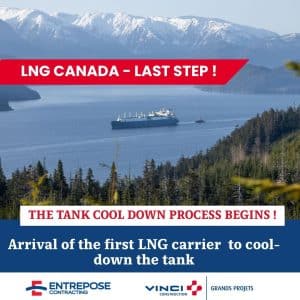
The arrival of the first LNG carrier marked a historic moment for the LNG Canada project. This inaugural cargo initiated...
At a glance




EPC, consortium Entrepose Contracting / Bouygues TP (Entrepose lead partner, ≈ 60%)


Dunkerque LNG is one of the largest LNG terminals in continental Europe, with an annual regasification capacity of 13 billion m³ (around 20% of French and Belgian demand). Located within the Grand Port Maritime de Dunkerque, the site has a strategic position between the English Channel and the North Sea, enabling direct connections to national networks.
The project, delivered by Entrepose Contracting in consortium with Bouygues TP, covered EPC for three of Europe’s largest tanks as well as all associated external electro-mechanical facilities, increasing complexity and scope, including:

Jean Caparros joined the Dunkirk LNG terminal construction project in 2011 as Project Manager, before taking on the role of Project Director during the construction phase. Three 190,000 m³ LNG storage tanks, a scope extending to external electromechanical installations, and construction activities carried out within an active port environment: he reflects on what made this project stand out from others.
What immediately set the Dunkirk project apart from other construction projects you had worked on?
First and foremost, its scale. The project involved the construction of three full-containment LNG storage tanks, each with a capacity of 190,000 m³, among the largest built in Europe at the time. Each tank measured 92 metres in diameter and 51 metres in height.
However, what really made the project distinctive was its scope. We were not simply building the tanks. Entrepose Contracting was also responsible for all the associated external electromechanical installations: approximately 65,000 diameter-inches of stainless steel piping, 1,000 tonnes of structural steelwork and 92 kilometres of electrical cables.
This combination added another dimension to the project. We had to construct the facilities while also managing all the interfaces required to ensure their successful integration into the terminal.
How did this extended scope affect construction management?
The broader the scope, the more critical interface management becomes. Civil works, tank construction, piping, electrical works, instrumentation and electromechanical installations all had to progress according to a coordinated approach.
A decision made in one discipline could affect the working conditions of another team. A delay in one area could push back an installation activity, a delivery or a test. It was therefore essential to have a clear and detailed understanding of the sequence of activities.
On a project of this nature, working in silos is simply not an option. Teams need to share information quickly and understand how their decisions affect other disciplines. This continuous coordination is what enables us to keep the schedule under control.
What were the main technical challenges?
The size of the tanks required specific construction methods. The prestressed concrete outer containment structures were built using climbing formwork, while the steel domes were assembled at ground level before being pneumatically raised into position.
These operations required meticulous preparation. Geometries, interfaces and execution conditions had to be carefully checked before each major construction phase.
The external piping and electromechanical works also presented significant challenges. Unlike activities carried out inside the tanks or in sheltered areas, these operations were directly exposed to the coastal weather conditions.
Every technical difficulty had to be assessed in terms of its potential impact on the project as a whole. As I often say: “We are generalists, and more than that: when a problem arises, we become specialists.”
How did the port environment influence the organisation of the works?
We were working within the Grand Port Maritime de Dunkerque, an industrial environment where port operations had to continue throughout construction. Site access, logistics flows and equipment movements therefore required close coordination.
Wind was another very tangible constraint. It could affect lifting operations, working at height and certain outdoor activities. We had to monitor weather conditions, adjust work sequences and sometimes reorganise the day’s activities.
This ability to adapt was essential. The construction schedule had to remain robust, but it could not be rigid. On site, you need to be able to change the sequence of operations without losing sight of the project’s overall objectives.
The works also had to comply with stringent environmental requirements due to the proximity of the marine environment and wetlands. These constraints were fully integrated into the planning and execution of construction activities.
Did delivering this project in France present any particular challenges?
Yes, because the context was different from that of our many international projects. We had to ensure compliance with French regulations and employment legislation, manage relationships with public authorities and integrate the construction site into the local industrial environment.
The project also attracted considerable attention. The terminal is a major energy infrastructure asset for France and Europe, with an annual regasification capacity of 13 billion cubic metres.
This level of visibility reinforced the need for rigorous project management. Providing technical solutions was not enough: we also had to anticipate stakeholder expectations and maintain an ongoing dialogue with the client, partners and local stakeholders.
What enabled the teams to stay on track during the most demanding periods?
We were a close-knit team. On a construction project of this scale, unforeseen challenges are inevitable. What makes the difference is how teams respond to them. You need to be able to raise issues quickly, bring together the right expertise and find solutions without wasting time.
Trust plays a vital role. When everyone understands the project’s priorities and is willing to share information, decisions can be made more quickly and solutions implemented more effectively.
At Dunkirk, this team spirit enabled people from very different professional backgrounds to work together towards a common objective: delivering safe, compliant facilities fully integrated into the terminal.
Why do you describe Dunkirk as a project that provided valuable on-the-job training?
The project gave us the opportunity to recruit and train people from the Dunkirk area. Some were discovering these professions for the first time, while others developed new skills by working alongside experienced teams.
On a major industrial construction site, much of the expertise is acquired directly in the field. People learn by observing, gaining hands-on experience and understanding why each quality or safety requirement matters.
“Being able to train people and bring them along with us was a source of personal pride. Some of them are still working in Entrepose offices today.”
Dunkirk was therefore about much more than building three LNG storage tanks. The project also helped transfer expertise and create long-term career opportunities.
Looking back, what stands out most about this project?
Dunkirk remains a landmark project because of its scale, but above all because of the range of challenges it brought together: three very large-capacity LNG storage tanks, an extensive electromechanical scope, numerous interfaces and a demanding port environment.
Success required a combination of technical expertise, forward planning, adaptability and teamwork. None of these elements would have been sufficient on its own.
What stands out most for me is the team’s ability to overcome challenges and develop together. The facilities we delivered are important, of course, but the skills developed and the people trained are equally part of the project’s success.